BEYOND NUCLEAR PUBLICATIONS

Search
JOIN OUR NETWORK


Follow Us on Twitter!

Canada

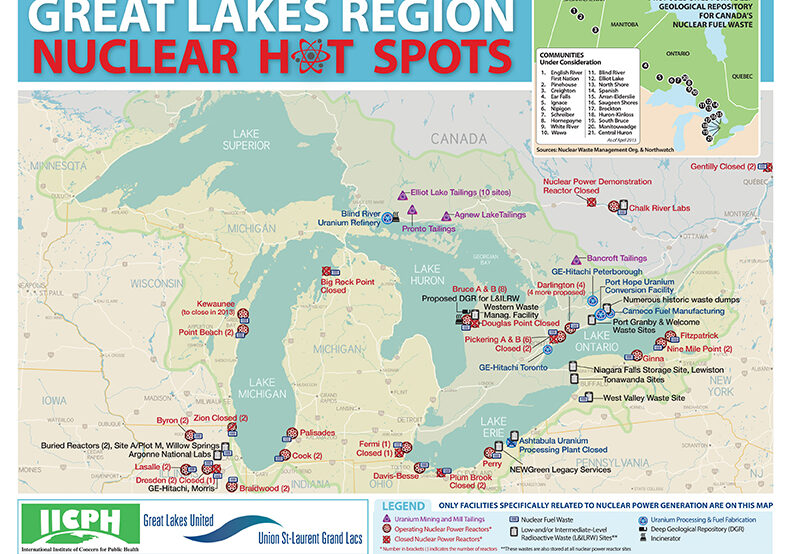
Canada is the world's largest exporter of uranium and operates nuclear reactors including on the Great Lakes. Attempts are underway to introduce nuclear power to the province of Alberta and to use nuclear reactors to power oil extraction from the tar sands.

.................................................................................................................................................................................................................

Thursday
May162013

Statements of opposition needed now to prevent national Canadian radioactive waste dump(s) on Great Lakes shore

Stop the Great Lakes Nuclear Dump billboard, seen by hundreds of thousands of commuters per day in the Toronto area

[Send your hand-written comments and questions about this insane proposal to:

Debra Myles; Joint Review Panel Secretariat; 160 Elgin St.; 22nd Floor; Ottawa, ON; K1A 0H3; Canada.

Or email them to:

DGR.Review@ceaa-acee.gc.ca.

You can also sign the online petition being circulated by the grassroots Bruce area environmental and residential group "Stop the Great Lakes Nuclear Dump." (See their Toronto area billboard, left)]

The federal Joint Review Panel (JRP) conducting an environmental assessment of Ontario Power Generation's (OPG) proposal to bury all of the province's so-called "low" and "intermediate" level radioactive wastes (L&ILRWs, from 20 atomic reactors across Ontario) in a "Deep Geologic Repository" (DGR) at the Bruce Nuclear Generating Station, 400 meters from the waters of Lake Huron, has announced that May 24th will close the time window for asking questions. Next stop, full hearings.

Bruce Nuclear Generating Station is one of the world's single biggest nuclear power plants. It "hosts" a total of 9 reactors, as well as incineration for 20 reactors' LLRWs, and warehouses for the leftover ashes, as well as ILRWs of Ontario. It is located a mere 50 miles across Lake Huron from Michigan. 

The Nuclear Waste Management Organization (NWMO), comprised of Canada's nuclear utilities, has taken over the L&ILRW DGR process. This is an alarming development, as the NWMO was created to find a DGR for high-level radioactive waste (HLRW), irradiated nuclear fuel. In fact, NWMO is working with several municipalities near Bruce, largely populated by Bruce nuclear workers, which have "volunteered" (in exchange for large amounts of funding -- is that really "volunteering"?!) to be considered for becoming Canada's HLRW DGR location, for 22 reactors' irradiated nuclear fuel (outside Ontario, there was a single reactor in Quebec -- now permanently shutdown -- and a single reactor in New Brunswick). 

As DGRs would cost billions, or tens of billions, to construct and operate (the U.S. Department of Energy's most recent estimate for the price tag on the Yucca Mountain dumpsite proposal approached $100 billion), it is very likely that the L&ILRW and HLRW DGRs at/near Bruce would be merged into a single dumpsite, to save billions or tens of billions of dollars on a second, redundant DGR nearby.

The Great Lakes comprise 20% of the world's surface fresh water. They provide drinking water to 40 million people in 8 U.S. states, 2 Canadian provinces, and a large number of Native American First Nations. As environmental, who instead refer to the DGRs as Deep Underground Dumps (that is, DUDs), have asked: would you bury poison beside your drinking water well?!

Please take this opportunity to help generate a flurry of concise statements of opposition aimed at preventing the Great Lakes shoreline from being turned into a permanent dumpsite for Ontario's L&ILRWs, and very likely all of Canada's HLRWs to follow.

Send your hand-written comments and questions about this insane proposal to:

Debra Myles; Joint Review Panel Secretariat; 160 Elgin St.; 22nd Floor; Ottawa, ON; K1A 0H3; Canada.

Or email them to:

DGR.Review@ceaa-acee.gc.ca.

You can also sign the online petition being circulated by the grassroots Bruce area environmental and residential group "Stop the Great Lakes Nuclear Dump." (See their Toronto area billboard, above left)

Tuesday
May072013

Entergy Watch: Environmental coalition challenges Entergy's financial qualifications to continue operating reactors, including near border with Canada

"Burning money" graphic by Gene Case, Avenging AngelsAs reported by E&E's Hannah Northey at Greenwire, an environmental coalition including such groups as Alliance for a Green Economy (AGREE), Beyond Nuclear, Citizens Awareness Network (CAN), and Pilgrim Watch, has launched an emergency enforcement petition at the U.S. Nuclear Regulatory Commission, challenging the financial qualifications of Entergy Nuclear to safely operate and decommission such reactors at FitzPatrick in New York, Pilgrim in Massachusetts, and Vermont Yankee. All three reactors happen to be twin designs to Fukushima Daiichi Units 1 to 4, that is, General Electric Mark I boiling water reactors. The coalition's petition cited financial analyses by UBS on Entergy's dire economic straits. Representatives from coalition groups, including Beyond Nuclear's Paul Gunter, testified today before an NRC Petition Review Board at the agency's headquarters in Rockville, MD. 

Vermont borders Quebec, and FitzPatrick is located on the Upstate NY shore of Lake Ontario, across the lake from Canada's biggest city, Toronto. Radiological risks to public health, safety and the environment do not respect state or international borders, after all.

FitzPatrick, Pilgrim, and Vermont Yankee have each already recieved 20-year license extension rubber-stamps from NRC. FitzPatrick, even though it never installed a hardened vent in the early 1990s, to deal with its too small, too weak containment -- the only one, of 23 Mark I in the U.S., to not do so. Pilgrim became the longest contested license extension -- a proceeding lasting over 6 years -- thanks to the efforts of Mary Lampert at Pilgrim Watch. And the Vermont Yankee license extension was actually blocked by the State of Vermont -- this court battle between and involving the state, Entergy, and NRC rages on in multiple federal and state venues.

In a Feb. 8, 2013 interview with Reuters, Entergy's brand new CEO, Leo Denault, admitted that one of the main financial challenges Entergy faces is the high cost of making vital safety repairs on its age-degraded reactors.

Wednesday
Mar272013

U.S.-Canadian environmental coalition defends contentions against Fermi 3 proposed new reactor, challenges adequacy of NRC FEIS

Environmental coalition attorney Terry LodgeTerry Lodge (photo, left), Toledo-based attorney representing an international environmental coalition opposing the proposed new Fermi 3 atomic reactor targeted at the Lake Erie shore in Monroe County, MI, has filed a reply to challenges from Detroit Edison (DTE) and the U.S. Nuclear Regulatory Commission (NRC) staff. The coalition includes such U.S. groups as Beyond Nuclear, and allies in Michigan (Citizens for Alternatives to Chemical Contamination, Don't Waste MI, and Sierra Club Michigan Chapter), and the Canadian group Citizen Environment Alliance of Southwestern Ontario. 

The coalition's reply re-asserted "no confidence" in DTE's ability to safely stored Class B and C "low-level" radioactive wastes on-site at Fermi 3 into the indefinite future, due to the lack of sure access to a disposal facility. it also again emphasized the lack of documented need for the 1,550 Megawatts of electricity Fermi 3 would generate. And the coalition alleged that NRC has failed to fulfill its federal responsibilities under the Endangered Species Act (ESA), the National Historic Preservation Act (NHPA), and National Environmental Policy Act (NEPA), as by the illegal "segmentation" of the needed transmission line corridor from the rest of the Fermi 3 reactor construction and operation proposal.

This legal filing follows by a week upon the submission of public comments about NRC's Fermi 3 Final Environmental Impact Statement (FEIS). The comments, commissioned by Don't Waste Michigan and prepared by Jessie Pauline Collins, were endorsed by a broad coalition of individuals and environmental groups, including Beyond Nuclear. The FEIS comments included satellite images of harmful algal blooms in Lake Erie in 2012, and in 2011 to 2012, attributable in significant part to thermal electric power plants such as Detroit Edison's Monroe (coal burning) Power Plant, at 3,300 Megawatts-electric the second largest coal burner in the U.S. Fermi 3's thermal discharge into Lake Erie will worsen this already very serious ecological problem.

In the very near future, the environmental coalition intervening against the Fermi 3 combined Construction and Operating License Application (COLA) will submit additional filings on its contentions challenging the lack of adequate quality assurance (QA) on the project, as well as its defense of the threatened Eastern Fox Snake and its critical wetlands habitat. The State of Michigan has stated that Fermi 3's construction would represent the largest impact on Great Lakes coastal wetlands in the history of state wetlands preservation law. 

Thursday
Feb212013

Fermi 3 Final Environmental Impact Statement incomplete: intervenors reveal major inadequacies; NRC announces major delays in Safety Evaluation Report; major setbacks projected

An artist's rendition of the ESBWR targeted to be built at Fermi 3On Feb. 19, 2013, the environmental coalition intervening in opposition to the construction and operation of Detroit Edison's proposed new Fermi 3 atomic reactor filed new and amended contentions in response to the U.S. Nuclear Regulatory Commission's Final Environmental Impact Statement about the proposal. The coalition issued a news release. As environmental coalition attorney Terry Lodge says in the press release, Fermi 3's price tag has skyrocketed to $20 billion.

The environmental coalition is international, including both U.S. and Canadian groups. The Fermi nuclear power plant is located in southeastern Michigan, just 8 miles across Lake Erie from Ontario, Canada.

Documents related to environmental intervenors' filing of Feb. 19, 2013 in opposition to the General Electric-Hitachi so-called "Economic Simplified Boiling Water Reactor" (or ESBWR, see image, left) proposed to be constructed and operated at the Fermi nuclear power plant in Monroe County, Michigan, on the Lake Erie shoreline, as well as documents reveal the major schedule delays afflicting the project:

Intervenors' Feb. 19, 2013 "MOTION FOR RESUBMISSION OF CONTENTIONS 3 AND 13, FOR RESUBMISSION OF CONTENTION 23 OR ITS ADMISSION AS A NEW CONTENTION, AND FOR ADMISSION OF NEW CONTENTIONS 26 AND 27";

Current Fermi 3 COLA Review Schedule (Feb. 15, 2013), showing 2 years and 10 month of delay;

Original Fermi 3 Schedule (June 30, 2009).

Tuesday
Feb052013

"Endangered Snakes Prompt Hearing Over Fermi 3 Nuclear Plant"

An Eastern Fox Snake, an endangered constrictor species indigenous to southeast MichiganThe Monroe Evening News has reported on an environmental coalition's successful bid for hearing before the U.S. Nuclear Regulatory Commission (NRC) Atomic Safety and Licensing Board (ASLB) in opposition to Detroit Edison's proposed new Fermi 3 atomic reactor on the Lake Erie shore of southeast Michigan.

The coalition is comprised of Beyond Nuclear, Citizens for Alternatives to Chemical Contamination, Citizens Environment Alliance of Southwestern Ontario, Don't Waste Michigan, and Sierra Club Michigan Chapter.

It contends that the nuclear utility, federal government, and State of Michigan are failing to protect the endangered Eastern Fox Snake species (see photo, left) from extinction due to habitat destruction caused by the construction and operation of a 1,550 Megawatt-electric General Electric Hiticahi so-called "Economic Simplified Boiling Water Reactor" (ESBWR), as well as an associated 11-mile long, 300-foot wide transmission line corridor.

The State of Michigan has admitted the reactor construction will involve the largest impact on Great Lakes coastal wetlands in the history of state environmental protection law. Combined with the transmission line's destruction of more than 1,000 acres of undeveloped land, including forests and wetlands, the coalition contends the habitat loss could extirpate the endangered Eastern Fox Snake species in the region. More.